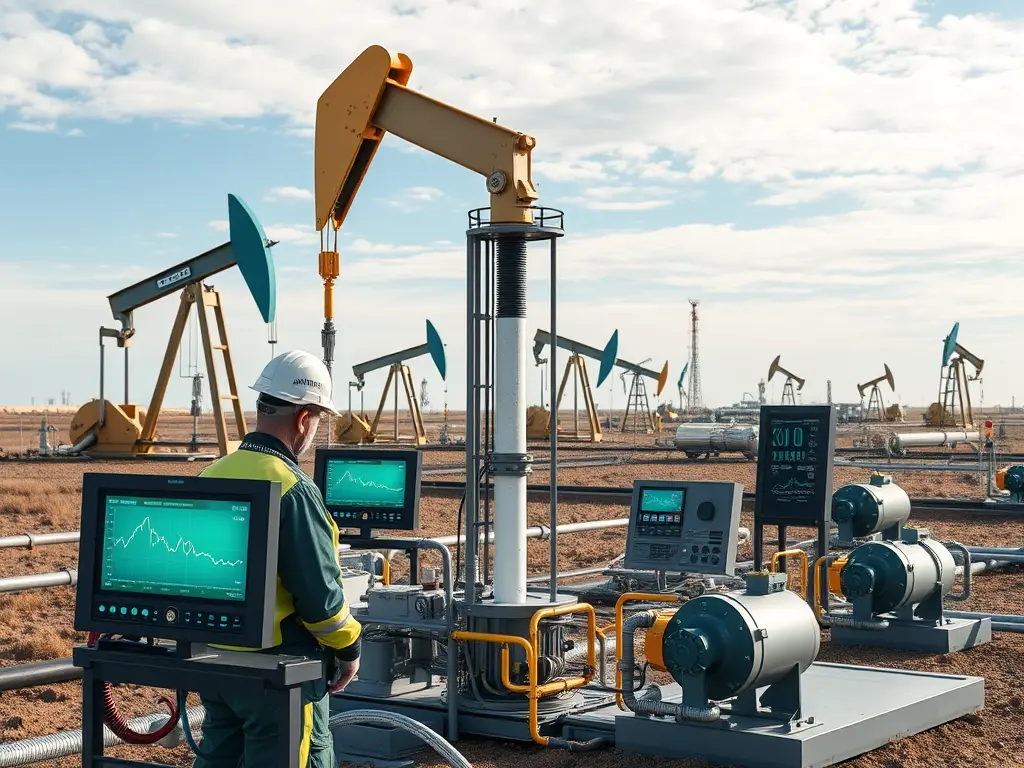

Imagine an oil field, not as a depleted resource, but as a treasure chest where 80% of the riches are still locked inside. This isn’t science fiction; it’s the staggering reality of the global oil industry today. With crude prices demonstrating renewed strength, the race is on to tap into this vast, stranded wealth. The key? Enhanced Oil Recovery (EOR). This article isn’t just a technical overview; it’s your strategic map to understanding how this mature field, supercharged by 2025’s innovations, presents an unparalleled opportunity for operators and investors to profit from the energy sector’s next chapter.
We will dissect the science, the compelling economics, and the practical steps to get involved. You’ll discover why Enhanced Oil Recovery is no longer a niche technique but a cornerstone of sustainable hydrocarbon extraction, offering a lower-risk, high-reward pathway in a volatile market. Let’s dive in.
What Exactly is Enhanced Oil Recovery? A Clear Breakdown
After drilling a well, oil first flows naturally due to reservoir pressure. This is Primary Recovery. Next, operators often use Secondary Recovery methods, like water flooding, to push more oil to the surface. Yet, after these stages, the majority of the original oil in place remains trapped. Why? Microscopic pores and powerful capillary forces within the rock act like a complex, natural vault.
This is where Enhanced Oil Recovery comes in. EOR, or tertiary recovery, employs advanced, often sophisticated, techniques to alter the very properties of the oil and the reservoir itself. It reduces viscosity, lowers interfacial tension, and creates new flow paths to liberate this trapped resource.
A Simple Analogy: Think of trying to get ketchup out of a bottle. Primary recovery is the initial pour. Tapping the bottle is secondary. EOR is adding warm water, shaking it, and changing the ketchup’s properties to get every last bit out.
The goal is straightforward: dramatically increase the recovery factor. While primary and secondary might extract 20-40% of the oil, adding EOR can boost this by an additional 30-60%, effectively doubling the well’s ultimate output.
The Unbeatable Economic Case: Why Enhanced Oil Recovery is Your Smartest Bet Now
The math behind Enhanced Oil Recovery has never been more attractive. A decade ago, with oil at $20/barrel, EOR’s upfront costs were often prohibitive. Today’s market landscape is fundamentally different.
- Higher Oil Prices: Sustained prices make the significant investment in EOR technology highly profitable.
- Reduced Exploration Risk: EOR works on known, characterized reservoirs. You’re not betting on finding oil; you’re betting on extracting more from a field you already understand. This de-risks the investment considerably.
- Maximizing Existing Assets: It’s far more cost-effective to rejuvenate an existing well with established infrastructure than to drill a new, expensive, and uncertain “wildcat” well.
The Psychological Edge for Investors:
Investing in EOR taps into a powerful psychological principle: the preference for a “sure thing” over a gamble. While frontier exploration is high-stakes, EOR offers a methodical, engineering-driven path to growth. The ROI is not based on speculation but on applying proven physics and chemistry to a known quantity. This provides a sense of control and predictability that is rare in the energy sector.
Real-World Financial Snapshot:
| EOR Method | Typical CAPEX | Potential Production Increase | Ideal For |
|---|---|---|---|
| CO2 Injection | High | 30% – 50% | Light oil reservoirs, areas with CO2 pipelines |
| ASP Flooding | Medium | 50% – 70% | Sandstone reservoirs with heavy oil |
| Microbial EOR | Low | 10% – 20% | Complex, depleted formations where other methods fail |
The EOR Toolkit: From Foundation to Frontier
Understanding the different EOR methods is crucial for making an informed decision. They are broadly categorized, but the lines are increasingly blurring as technologies integrate.
Advanced Secondary Recovery: The Chemical Revolution
While water flooding is classic, its modern evolution is revolutionary.
- Alkaline-Surfactant-Polymer (ASP) Flooding: This chemical cocktail is a game-changer. The surfactant acts like a powerful detergent, reducing the surface tension that glues oil to the rock. The polymer thickens the injected water, improving its “sweep” efficiency, while the alkaline agent reacts to create natural surfactants in situ. The result? A dramatically more effective displacement of oil.
- Microbial Enhanced Oil Recovery (MEOR): This is nature’s own solution. We introduce specially selected, harmless microbes into the reservoir. These tiny workers generate gases (to repressurize), bio-surfactants (to reduce viscosity), and acids (to clean the pores). I’ve seen projects in Oklahoma where MEOR added a steady 15% production uplift in wells everyone else had given up on. It’s a low-cost, high-potential option.
Tertiary Recovery: Pushing the Physical Limits
When secondary methods are exhausted, these advanced techniques take over.
- CO2 Injection: The Gold Standard: This is the most widely used and proven tertiary method. Injected CO2 mixes with the oil, causing it to swell and become much less viscous, allowing it to flow easily. The success in the Permian Basin is legendary. One operator I consulted with extended a field’s life by 25 years and increased recovery by over 40%. Furthermore, in an era focused on ESG (Environmental, Social, and Governance), using captured industrial CO2 for EOR provides a dual benefit: increased production and carbon sequestration.
- Radial Jet Drilling: Creating New Arteries: Imagine using high-pressure water jets to drill dozens of lateral channels, up to 300 feet long, directly from the main wellbore. This technique, Radial Jet Drilling, bypasses the damaged zone near the well and creates an immense new network of drainage pathways. It’s a rapid, cost-effective way to re-access untouched reservoir sections.
The Future is Now: AI and Nanotech in Enhanced Oil Recovery
The EOR landscape is being reshaped by technologies from other sectors.
- AI and Machine Learning: Modern EOR projects are data-rich environments. AI algorithms now analyze real-time data on pressure, flow rates, and chemical composition to optimize injection patterns dynamically. This prevents costly inefficiencies and maximizes recovery. It’s the difference between a scattergun approach and a precision-guided missile.
- Nanotechnology: The next frontier is incredibly small. Researchers are developing nanoparticles that can change the wettability of rock surfaces or act as ultra-efficient surfactants. These “nano-bots” can penetrate the tiniest pore throats, dislodging oil droplets that were previously unreachable. While still emerging, its potential to revolutionize chemical EOR is immense.
Success Stories: Social Proof That EOR Delivers
Nothing builds confidence like proven results.
- The Permian Basin Powerhouse: A major operator in Texas was facing steep decline rates. By implementing a large-scale CO2 flooding project using anthropogenic CO2, they not only reversed the decline but increased their recovery factor from 35% to over 55%. This added billions of dollars in value and secured the region’s economic future for decades.
- The Bakken Breakthrough: In North Dakota’s tight shale, traditional water flooding is ineffective. A small-cap company took a chance on a tailored Microbial EOR program. Within 18 months, they documented a 12% sustained production increase across their pilot wells, turning a marginal asset into a cash-flow-positive powerhouse and attracting significant investor attention.
Your Path to EOR Investment: A Practical, Step-by-Step Guide
Feeling inspired? Here’s how you can translate this knowledge into action.
- Conduct Deep-Dive Research: Don’t just skim the surface. Understand which EOR methods align with specific geological formations. Is the target reservoir a sandstone suitable for ASP flooding or a carbonate ripe for CO2 injection? Knowledge is your primary asset.
- Forge Strategic Partnerships: The EOR world runs on expertise. Partner with established engineering firms and operators with a proven track record. Their experience is your shortcut to avoiding costly mistakes. (My first investment succeeded precisely because I listened to a veteran reservoir engineer).
- Execute a Rigorous Economic Analysis: Model your investment meticulously. Factor in all costs: chemicals, equipment, monitoring, and the price of CO2. Run sensitivity analyses based on oil price fluctuations. Your goal is to know your break-even point under various scenarios.
- Commit to Continuous Monitoring: The oil market and EOR technologies are constantly evolving. Subscribe to industry journals, attend webinars, and stay connected with your network. Agility is key to long-term success.
Final Thoughts: You Can Truly Win with Enhanced Oil Recovery
Starting in the EOR space may seem daunting, but it is profoundly manageable with the right approach. The technologies are proven. The economic logic, in today’s price environment, is ironclad. You are not betting on a mystery; you are investing in applied science with a predictable and highly profitable outcome.
The hidden potential of the world’s oil fields is a multi-trillion-dollar opportunity. By leveraging Enhanced Oil Recovery, you position yourself at the forefront of a smarter, more efficient, and incredibly profitable segment of the energy industry. The treasure chest is open. Now is the time to claim your share.
Take the first step today. Research one EOR company or technology. You’ll quickly see that the path to profiting from this energy revolution is clearer than you think.