
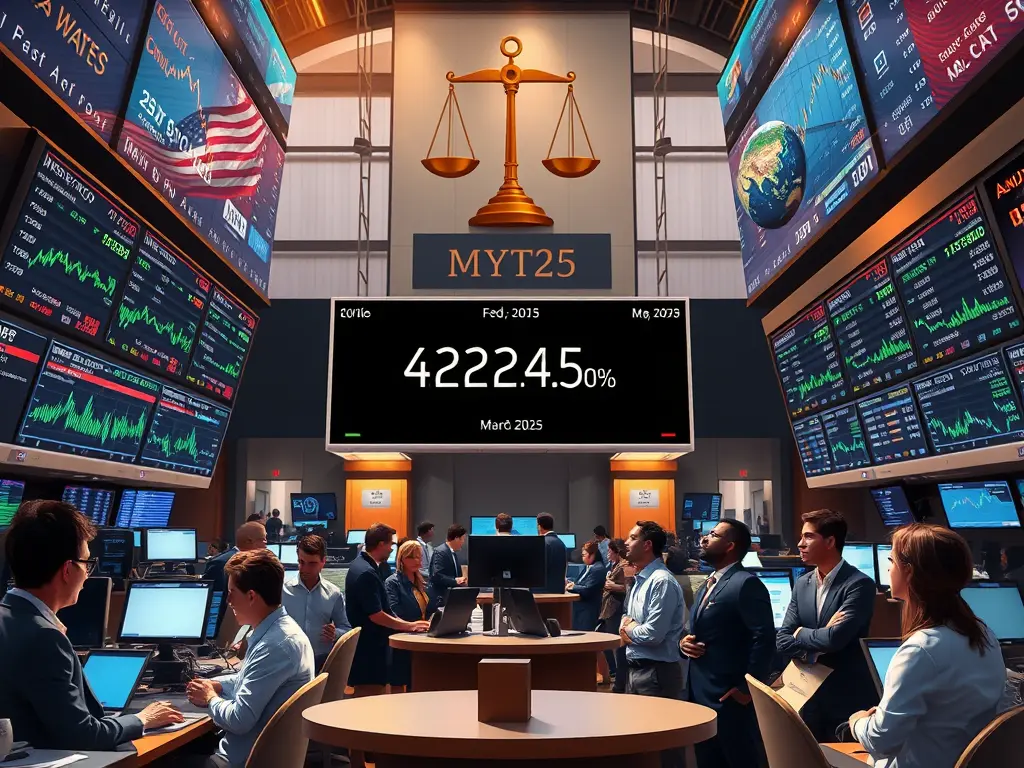
The Federal Reserve just hit the pause button, and your investment portfolio is listening intently. In a move that echoed across trading floors worldwide, the U.S. Federal Reserve concluded its March 2025 meeting by holding the federal funds rate steady within the 4.25%-4.50% range. This decision, while widely anticipated, sends a powerful message about the state of the American economy and the tricky path ahead. For investors, understanding the implications of these sustained interest rates is no longer just a skill—it’s a necessity for safeguarding and growing wealth in a complex market.
This article will serve as your strategic guide. We’ll dissect the Fed’s reasoning, analyze market psychology, and provide a clear, actionable blueprint for adjusting your investment strategy. The era of near-zero interest rates is a distant memory; it’s time to adapt, thrive, and turn monetary policy into your personal profit engine.
Market Pulse: How Interest Rates Shook the Markets
Financial markets breathed a sigh of relief, but it was a nervous one. The Fed’s decision to hold interest rates created a whirlwind of volatility. Stock indices swung between gains and losses as investors deciphered the central bank’s statement for clues about the future.
Equity Markets on Edge
The S&P 500 experienced a classic “buy the rumor, sell the news” event. Technology stocks, which are particularly sensitive to financing costs, saw sharp declines before stabilizing. Conversely, the banking sector, which benefits from higher lending margins, showed modest gains. This split personality highlights the market’s uncertainty. Investors are grappling with a new reality where growth is no longer the only priority.
The Bond Market’s Adjustment
The bond market told a more nuanced story. The yield on the 10-year Treasury note initially spiked before settling slightly higher. This “adjustment dance” reflects the market’s recalibration of long-term inflation expectations. The message is clear: the market believes the Fed is committed to its fight, but the war is not yet over. This immediate reaction underscores a critical point. Market movements are not just about cold, hard data. They are a real-time reflection of collective investor sentiment—a blend of fear, greed, and interpretation.
The Fed’s Tightrope Walk: The Interest Rates Strategy for 2025
So, why did the Fed choose inaction? The answer lies in a delicate balancing act. The central bank is walking a tightrope strung between two daunting chasms: rampant inflation and potential economic stagnation.
The Persistent Inflation Problem
Inflation, while down from its peak, remains stubbornly above the Fed’s 2% target. Core CPI data from February 2025 showed a 2.8% annual increase, signaling that underlying price pressures are persistent. The Fed’s decision signals that their priority remains price stability. They are willing to tolerate slightly slower growth to avoid inflation becoming entrenched. This cautious approach aims to ensure long-term economic health, even if it requires short-term patience from markets.
Global Pressures and Data Dependence
Furthermore, global complexities add layers to their decision-making. Ongoing trade negotiations with the EU and volatile energy prices due to tensions in the Middle East create imported inflationary pressures. The Fed is not operating in a vacuum; it must account for these global crosscurrents. As one Fed official noted, “We are data-dependent, not date-dependent.” This means every future meeting is live, and a single bad inflation report could trigger a rate hike. This forward guidance is crucial for investors to monitor.
The Investor’s Mind: Navigating Fear and Greed in a High Interest Rates Era
Let’s talk psychology. When the Fed holds interest rates high, it taps into deep-seated investor emotions. Understanding this is half the battle.
Conquering Analysis Paralysis
I recall speaking with a client in late 2024 who was terrified of “missing out” on a stock market rally. He wanted to go all-in. However, the data suggested caution. This is a classic example of FOMO (Fear Of Missing Out) clashing with rational analysis. In the current climate, the dominant emotion is often analysis paralysis—the inability to act due to overthinking every variable. Breaking down decisions into smaller, manageable steps can overcome this inertia.
The Danger of Recency Bias
A powerful psychological phenomenon to watch is recency bias. Investors who started their journeys in the low-rate 2010s are conditioned to expect cheap money and soaring stock prices. The current environment of high interest rates feels alien and dangerous. This can lead to poor decisions, like abandoning a long-term strategy for the perceived safety of cash, which is itself eroded by inflation.
Ask Yourself:
- Q: Do I feel anxious about my investments when I see market volatility?
- A: This is completely normal. The key is to have a plan so robust that your emotions don’t derail it.
Your 2025 Investment Playbook: Actionable Strategies
The Fed’s decision is not a signal to retreat. It’s a call to strategize. Here is your actionable playbook for navigating this environment.
1. Embrace Strategic Diversification
Forget simply owning stocks and bonds. True diversification now means allocating across non-correlated assets. This is your best defense against volatility. Consider Real Estate Investment Trusts (REITs) and commodities. I’ve personally increased my allocation to infrastructure-focused REITs. These often have inflation-linked leases, making them a fantastic hedge. Similarly, a small position in gold can act as portfolio insurance.
2. The Power of Dividend Aristocrats
In a world where capital growth may be slower, income investing shines. Focus on companies with a long history of paying and increasing dividends—the so-called “Dividend Aristocrats.”
| High-Growth Tech Stock | Dividend Aristocrat (e.g., Consumer Staples) |
|---|---|
| Potentially high volatility | Lower volatility and stable returns |
| Relies on capital appreciation | Provides consistent income stream |
| Hurt by rising financing costs | Benefits from pricing power in inflation |
As you can see, dividend payers can provide a ballast in rocky seas.
3. Leverage Fixed Income Wisely
Interest rates are high, but that’s good news for bond investors! You can now lock in attractive yields. Instead of fearing the bond market, embrace it.
- Ladder Your Bonds: Create a portfolio of bonds with staggered maturity dates (e.g., 1, 2, 3, 4, and 5 years). As each matures, you can reinvest the cash at the prevailing, potentially higher, interest rates.
- Consider TIPS: Treasury Inflation-Protected Securities (TIPS) are government bonds that adjust their principal value based on inflation. They are a direct tool for protecting your purchasing power.
Success in Volatility: Learning from Those Who Thrived
History doesn’t repeat itself, but it often rhymes. Let’s look at some social proof.
During the rate hike cycle of 2022-2023, many investors panicked. However, those who focused on quality companies with strong balance sheets and pricing power were rewarded. A colleague of mine diligently invested in a semiconductor company that dominated its niche. Despite higher interest rates, the company’s innovative edge and global demand allowed it to thrive. His patience paid off handsomely.
Another example is the real estate market in the Sun Belt. While national headlines predicted a crash, markets in cities like Nashville and Atlanta, fueled by demographic shifts and job growth, remained resilient. Investors who focused on these fundamental trends, rather than broad fears, continued to see solid returns. This proves that even in a challenging macro environment, micro-opportunities abound. You can achieve this too.
Looking Forward: Your Path to Financial Confidence
The Fed’s pause is a chapter, not the whole story. The coming months will be dictated by data—employment reports, consumer spending, and most importantly, inflation figures.
Your Tactical To-Do List:
- Stay Informed, Not Overwhelmed: Bookmark the Bureau of Labor Statistics website. Check the CPI and PPI reports each month.
- Revisit Your Risk Tolerance: Be honest with yourself. Has it changed? Adjust your asset allocation accordingly.
- Automate Your Investments: Use dollar-cost averaging to invest a fixed amount regularly. This removes emotion from the process and smooths out your purchase price over time.
Seize the Opportunity: It’s Your Time to Win
Let’s be clear: the current financial landscape is not a barrier; it’s a filter. It separates the reactive from the strategic. The Fed’s decision on interest rates has set the stage. Now, it’s your turn to perform.
You Have the Tools for Success
You now hold a powerful toolkit, complete with an understanding of the psychological triggers that can derail a portfolio and a playbook of actionable strategies. From the steady income of dividend investing to the strategic safety of bond ladders, you are fully equipped. The only question that remains is not what you should do, but when you will begin.
Embrace the Challenge and Reap the Rewards
Investing in this climate is undoubtedly a challenge. But with challenge comes immense opportunity. History rewards those who stay disciplined when others are fearful. Trust in the strategy you build. Keep your focus on the long-term horizon. Take that first confident step today.
Your future, wealthier self will thank you for the courage you show now. The market is waiting for you. Go and claim your share.
How to Get Started & Reap the Rewards:
Starting is easier than you think, and the potential for building lasting wealth is real. Here’s a simple, encouraging guide to begin:
- Audit Your Portfolio: This weekend, take one hour to list all your investments. Categorize them (stocks, bonds, cash). This clarity is empowering.
- Open a Side Account: If you’re nervous about changing your main portfolio, open a separate brokerage account with a small amount. Test your new strategy here—it’s a risk-free way to build confidence.
- Set Up Alerts: Use free financial news apps to set alerts for “Federal Reserve” and “CPI.” Staying informed takes minutes a week.
- Celebrate Small Wins: Did your dividend get paid? Did your bond ladder execute a reinvestment? Acknowledge these successes! This positive reinforcement builds a healthy investing mindset.
The ease of managing a modern portfolio through low-cost ETFs and user-friendly apps has never been greater. The potential profitability of a well-structured portfolio in a high-interest rate environment is significant. You are not just saving; you are actively building a fortress of financial security. Begin now. You’ve got this.