
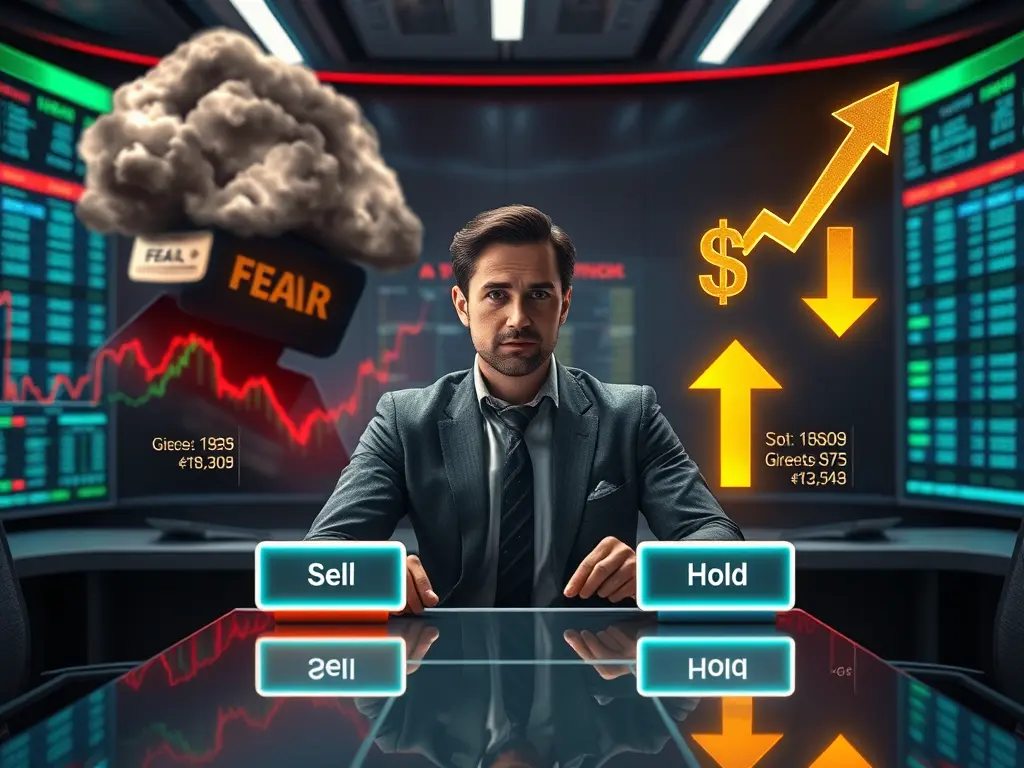
What if your biggest obstacle to stock market success isn’t the economy, but your own mind? In the whirlwind of 2025’s global uncertainties—from geopolitical shifts to AI disruptions—understanding the hidden forces driving your decisions is no longer a luxury; it’s a necessity for survival and prosperity. This article is your deep dive into the world of investor psychology, the invisible hand that often steers the market more powerfully than any earnings report. We will equip you with the strategies to not just understand this force, but to harness it for your financial gain.
The financial landscape of 2025 is a complex tapestry. It’s woven with threads of technological innovation and geopolitical tension. Traditional analysis alone is like navigating a stormy sea with an outdated map. Your portfolio’s performance is intrinsically linked to your ability to manage fear, greed, and bias. By mastering investor psychology, you gain a critical edge. You can transform emotional reactions into strategic responses. This is the foundation of building lasting wealth in these volatile times.
How Investor Psychology Makes Your Brain Your Biggest Hurdle
We like to think of ourselves as rational beings, especially with our money. However, decades of behavioral finance research prove otherwise. Our brains are hardwired with shortcuts and emotional triggers—a legacy from a time when avoiding predators was more urgent than analyzing P/E ratios. These ingrained patterns, known as cognitive biases, systematically lead us astray. They cause us to buy at peaks out of excitement and sell at troughs out of panic. Recognizing these patterns is the first step toward disarming them.
Personal insight: I once held onto a losing position for months, watching it sink simply because I couldn’t admit my initial analysis was wrong. The pain of realizing a loss felt more profound than the logical need to preserve capital. This is a classic example of a bias we’ll discuss next. It was a costly but invaluable lesson in self-awareness.
The Four Horsemen of Financial Apocalypse: Key Investor Psychology Biases
Let’s break down the most destructive biases you’ll face in 2025 and how they manifest.
1. Loss Aversion: The Fear of Feeling the Pain
This is the cornerstone of behavioral finance. Studies show the pain of losing $100 is psychologically about twice as powerful as the pleasure of gaining $100. This leads to disastrous behaviors like holding onto plummeting stocks, hoping for a break-even point that may never come (the “falling knife” problem). In 2025, with rapid sector rotations, this bias can cause you to miss new opportunities by anchoring you to your past mistakes.
How to Combat It:
- Set pre-defined stop-loss orders for every trade. This automates the exit strategy, removing emotion from the moment of crisis.
- Reframe your thinking: A realized loss is not a failure. It is a strategic cost of doing business and freeing up capital for a better opportunity.
2. Overconfidence: The Illusion of Control
After a few winning trades, it’s easy to feel invincible. This overconfidence bias makes us overestimate our knowledge and underestimate risks. It leads to excessive trading, concentrated positions, and ignoring contrary evidence. In the era of AI and complex financial instruments, this bias is more dangerous than ever.
How to Combat It:
- Keep a trading journal. Document the reasoning behind every trade, not just the outcome. This creates objective data to review, highlighting when you were lucky versus when you were truly skillful.
- Actively seek out disconfirming evidence. Before hitting “buy,” write down three reasons why the trade might go wrong.
3. Herd Mentality: The Comfort of the Crowd
Humans are social creatures. There is a deep-seated comfort in following the crowd. In markets, this creates bubbles and brutal crashes. We saw this in the 2024 crypto rallies and the subsequent “alt-season” collapse. The fear of missing out (FOMO) on the next big thing drowns out our critical voice.
How to Combat It:
- Ask yourself: “Am I buying this because of its fundamental value, or because everyone else is?” If you can’t articulate a clear, fundamental thesis, step away.
- Remember the words of Warren Buffett: “Be fearful when others are greedy, and greedy when others are fearful.” This is the antithesis of herd behavior.
4. Recency Bias: The Hypnosis of the Present
Our brains give excessive weight to recent events while discounting long-term historical trends. A week of green markets breeds irrational optimism; a few days of red incites panic about a prolonged bear market. This bias blinds us to the cyclical nature of markets.
How to Combat It:
- Zoom out. Always look at long-term charts (5-10 years) to regain perspective. The 2020 crash seemed like the end of the world, yet it was a blip in the long-term bull market.
- Implement dollar-cost averaging. By investing a fixed amount regularly, you automatically buy more shares when prices are low and fewer when they are high, smoothing out the impact of volatility.
2025 Battle Plan: Strategies to Stay Sane and Profitable
Knowing the enemy is half the battle. Here’s your actionable plan for the year ahead.
Cultivate a Long-Term, Disciplined Mindset
The most successful investors are not necessarily the smartest, but the most disciplined. They stick to a well-crafted plan. Your strategy should be your anchor.
- Focus on Quality: Build a core portfolio of fundamentally strong companies or low-cost index funds. This provides stability.
- Ignore the Noise: The 24/7 news cycle is designed to trigger your emotional biases. Limit your consumption of financial media.
Implement Ironclad Risk Management
Hope is not a strategy. Your risk management rules are.
- Use Stop-Loss and Take-Profit Orders: Automate your exits. This is non-negotiable.
- Diversify Intelligently: Don’t put all your eggs in one basket, even if it’s a trendy tech basket. Spread your risk across asset classes and geographies.
Practice Radical Self-Awareness
Your portfolio is a mirror of your psyche. Regular self-reflection is crucial.
- Weekly Reviews: Spend 30 minutes each week reviewing your journal. What emotions drove your decisions? Fear? Greed? Overconfidence?
- Meditate: It sounds unconventional, but mindfulness practices train your brain to observe emotions without acting on them impulsively. This is a superpower in trading.
Learning from the Past: Case Studies in Market Psychology
The Tesla Rollercoaster (2020-2025): Tesla’s meteoric rise was a masterclass in herd mentality and FOMO. Early investors, who bought based on a long-term vision for electric vehicles, were rewarded handsomely. However, those who FOMO’d in at the 2021 peak, driven by social media hype and ignoring valuation concerns, suffered significant drawdowns. The lesson? The crowd is often late to the party.
The COVID-19 Crash & Recovery (2020-2023): This was the ultimate test of investor psychology. The fear in March 2020 was palpable. Many sold everything at the bottom, cementing their losses. Yet, those who understood market history and controlled their fear—or even deployed capital into high-quality names at a discount—were rewarded with one of the strongest bull markets in history. It wasn’t about predicting the bottom; it was about having the emotional fortitude to stay the course.
Your Blueprint for Success in 2025 and Beyond
So, how can you, starting today, use investor psychology to build wealth? It’s simpler than you think, but it requires commitment.
- Start with Education: You’re already doing this by reading this article. Continue learning about behavioral finance.
- Create Your Rules: Before your next trade, write down your personal trading rules. What are your criteria for entering and exiting a position? What is your maximum risk per trade?
- Open a Practice Account: If you’re new, test your strategies and your emotional responses without risking real money.
- Build a Simple Portfolio First: You don’t need to pick individual stocks. A portfolio of a few broad ETFs is a fantastic, low-stress way to start.
- Automate Your Investments: Set up automatic monthly transfers to your investment account. This enforces discipline and leverages dollar-cost averaging.
You absolutely can do this. The markets of 2025 are not a casino for the privileged few. They are a field of opportunity for the disciplined, the self-aware, and the patient. By focusing on controlling your internal world, you position yourself to profit from the chaos of the external one. The journey of mastering investor psychology is a lifelong pursuit, but it is the most rewarding investment you will ever make.
Stop letting your emotions dictate your financial future. Take control today. The market is waiting, and it rewards the brave and the disciplined. Happy investing